Tesla has given itself considerably more borrowing capacity at a moment when building its vision of the future is becoming much more expensive.
On September 29, Tesla entered three credit agreements totaling $30 billion: a $20 billion delayed-draw term-loan facility, an $8 billion five-year revolving facility and a $2 billion 364-day revolving facility.
But the headline number requires an important qualification.
Tesla has not borrowed $30 billion. It has not announced a $30 billion investment. And its regulatory filing does not assign this money to Cybercab, Optimus, artificial-intelligence infrastructure, solar manufacturing or its semiconductor collaboration with SpaceX.
Tesla told investors that the facilities can be used for general corporate purposes or other uses permitted under the agreements. No loans were outstanding under them when the company filed the agreements, and Tesla said it does not currently plan to draw on them during 2026.
So why arrange so much financing now?
Tesla held about $43.5 billion in cash, cash equivalents and short-term investments at the end of June. At the same time, its capital spending has accelerated as the company tries to build businesses whose potential returns may arrive years after the infrastructure required to support them.
The $30 billion package does not tell investors exactly what Tesla will build with borrowed money.
It tells them something different: Tesla wants significantly more financial flexibility while attempting one of the largest transformations in its history.
The $30 billion is more complicated than it looks
The financing consists of three distinct pieces with very different timelines.
The largest is a $20 billion senior unsecured delayed-draw term loan. Tesla can borrow against it up to 10 times during the first 18 months.
But the entire unused $20 billion does not remain available for that full period.
The undrawn commitment automatically falls to $10 billion after one year and then $5 billion after 15 months. Any remaining unused commitment disappears after 18 months. Money actually borrowed under the facility matures in September 2029.
That makes the $20 billion component less like a permanent reserve and more like a large financing window Tesla can choose to use as its investment plans develop.
The other $10 billion consists of revolving credit.
An $8 billion facility runs for five years, through September 2031, while another $2 billion facility lasts 364 days, with an option under certain conditions to extend outstanding loans for an additional year. Tesla can also seek as much as another $4 billion of revolving commitments if lenders agree and other conditions are satisfied.
Tesla pays fees for maintaining unused commitments, and any money it actually borrows carries variable interest rates tied to benchmarks such as SOFR plus a margin based partly on its credit rating.
The company also agreed to maintain at least $5 billion in consolidated liquidity.
In other words, this is financial flexibility with deadlines, conditions and costs.
Tesla replaced a much smaller safety net
The comparison with Tesla’s previous credit arrangement shows how significantly that flexibility has expanded.
When Tesla entered the new agreements, it terminated an existing $5 billion revolving credit facility that had been scheduled to mature in January 2028.
Tesla had not borrowed anything under that facility either.
That matters.
Tesla replaced an unused $5 billion facility with a package carrying as much as $30 billion of initial commitments. It did so while already holding substantial liquidity.
At June 30, the company reported approximately $43.52 billion in cash, cash equivalents and short-term investments.
That shifts the central question.
Why does a company with tens of billions of dollars already available want the option to borrow tens of billions more?
The answer becomes clearer when looking at how quickly Tesla’s investment requirements are changing.
Tesla expects capital spending to nearly triple
Tesla spent $8.53 billion on capital expenditures in 2025.
Its expected 2026 spending has since risen to more than $25 billion, as the company invests heavily in AI compute, manufacturing capacity and businesses beyond conventional vehicle production. Reuters reported in September that much of Tesla’s record spending this year is expected to support AI computing infrastructure, solar-cell manufacturing capacity and other expansion efforts.
That is an enormous increase in a short period.
Tesla is investing in several businesses alongside vehicle production: autonomous transportation, humanoid robots, increasingly powerful AI systems, energy infrastructure and new manufacturing capabilities.
Some of those businesses require large amounts of capital before their ultimate economics are known.
That creates a timing problem.
Tesla can spend money building the infrastructure today while waiting years to learn how much revenue that infrastructure eventually produces.
Additional borrowing capacity gives it another way to bridge that gap.
The AI infrastructure is already being built
Artificial intelligence is among the clearest examples.
Training the systems behind autonomous driving and robotics requires substantial computing resources: high-end processors, networking equipment, data centers, electrical capacity and cooling infrastructure.
Tesla has already been expanding those resources in Texas.
An earlier company plan called for building a second major AI-compute cluster known as Cortex 2 and substantially increasing onsite computing capacity.
That plan has since moved forward.
Tesla subsequently reported that Cortex 2 was online and running training workloads, with additional expansion planned.
This is no longer simply Tesla discussing a future AI data center. The infrastructure is operating, and Tesla is preparing to expand it further.
But AI compute by itself does not produce the economic return Tesla ultimately needs.
Its value depends on what the resulting models allow Tesla to commercialize.
That leads directly to two of the company’s largest bets: autonomous transportation and humanoid robotics.
Cybercab and Optimus need the spending to eventually produce something
Tesla’s long-term valuation has increasingly become tied to businesses that extend beyond selling cars.
Cybercab represents one of the most important.
The company is attempting to move from selling vehicles equipped with increasingly sophisticated driver-assistance software toward operating autonomous transportation at scale.
If that works, Tesla could potentially earn recurring revenue from vehicles providing rides rather than primarily earning money when a customer purchases a car.
Optimus pushes the strategy even further.
Tesla is attempting to develop general-purpose humanoid robots capable of performing physical work—another market that could theoretically become enormous but remains far less mature than its automobile business.
Both ambitions depend heavily on AI.
Both require substantial upfront investment.
And neither should be treated as guaranteed to produce returns simply because Tesla is spending money on them.
That distinction is crucial to understanding the credit facilities.
Tesla’s filing does not say the $30 billion is Cybercab financing or Optimus financing.
Instead, the facilities give the company greater freedom to manage its overall finances while projects like these consume increasingly large amounts of capital.
Terafab shows both the ambition and the uncertainty
Tesla’s semiconductor collaboration with SpaceX illustrates why those qualifications matter.
In August, Reuters reported that SpaceX and Tesla planned an initial $16.8 billion investment in a Texas semiconductor manufacturing complex known as Terafab. The proposed facility is intended to manufacture and package advanced chips for future computing needs.
That figure is relevant to the scale of infrastructure Musk’s companies are contemplating.
It is not a $16.8 billion Tesla bill.
Terafab is a joint effort, and available disclosures do not establish how much of that initial investment Tesla itself will ultimately finance. Nor does Tesla’s new credit filing say these particular facilities will pay for Terafab.
Earlier SpaceX disclosures to the SEC describe a general framework with Tesla for developing Terafab. They say specific projects would require separate negotiations and agreements, while development timelines, milestones and capital expenditures remained subject to future decisions at the time of those disclosures.
That is why the $30 billion should be interpreted as financing flexibility rather than a project budget.
Tesla is positioning itself to pursue expensive opportunities without telling investors that every dollar has already been assigned.
Why borrow when Tesla already has $43.5 billion?
This may be the most interesting financial question raised by the announcement.
A company with more than $43 billion in cash and short-term investments does not necessarily need to borrow money simply because it wants to build something.
But maintaining large cash reserves while arranging external credit can provide flexibility.
Tesla could preserve liquidity for operating needs, unexpected expenses or acquisitions while financing some investments externally.
It could draw credit if capital expenditures rise faster than expected.
It could leave the facilities unused if cash generation proves sufficient.
And it can make those decisions later, when management has more information about vehicle sales, margins, AI investment requirements and the progress of newer businesses.
There is a cost to maintaining that optionality. Tesla must pay commitment fees on the unused revolving facilities and ticking fees on undrawn term-loan commitments.
But for a company contemplating tens of billions of dollars in spending, paying for access to additional capital can be valuable even if it ultimately never borrows most of it.
That appears to be what Tesla is buying today: options.
What would show that the spending is working?
The size of Tesla’s investment plans makes measuring their results increasingly important.
More data centers are not, by themselves, proof that Tesla’s AI strategy is succeeding.
Neither are more robots produced, more Cybercabs manufactured or more factories announced.
Eventually, the investments have to produce economic results.
For autonomous driving, that could mean expanding driverless commercial service, increasing utilization and demonstrating attractive economics at scale.
For Optimus, it would mean moving beyond demonstrations and internal deployment toward repeatable production and paying customers.
For AI infrastructure, the question is whether additional compute materially improves the systems underlying those products.
For manufacturing investments, the question is whether Tesla can turn additional capacity into profitable output.
And across the company, investors can watch whether operating cash flow ultimately grows enough to support the dramatically higher capital requirements without sustained dependence on new borrowing.
Those measurements matter because Tesla’s capital-spending surge arrives before many of the businesses it is funding have proven their long-term economics.
The credit package gives Tesla more time and flexibility.
It does not remove the requirement that those investments eventually earn a return.
What the $30 billion actually tells us
Tesla’s new financing says less about any single factory than the headline number initially suggests.
There is no disclosed $30 billion Cybercab fund.
There is no disclosed $30 billion AI budget.
And there is no evidence that Tesla intends to immediately add $30 billion of debt to its balance sheet.
Instead, the company has created a financing structure that can evolve with its needs.
The $20 billion term-loan commitment begins shrinking if Tesla does not use it. The revolving facilities last longer. Tesla says it does not currently intend to draw on any of them during 2026. And the company entered the agreements after reporting more than $43 billion in cash and short-term investments at the end of June.
Those details make the announcement more interesting.
Tesla is preparing financially for a period in which it may have to spend enormous amounts before knowing exactly which of its newer businesses will become major profit centers.
Cortex 2 is already running AI workloads.
Cybercab and Optimus remain central to Tesla’s future ambitions.
Solar manufacturing is expanding.
And Tesla and SpaceX are pursuing a semiconductor strategy whose eventual capital requirements for each company remain unclear.
The $30 billion package does not tell us which of those bets will work.
It tells us Tesla wants the financial capacity to keep making them.
For the next several years, Tesla is attempting to become a broader AI, robotics, autonomy and energy company alongside its electric-vehicle business.
Now it has to demonstrate that the businesses requiring all that capital can eventually produce returns large enough to justify it.
Sources
- Tesla / SEC — September 29, 2026 Form 8-K
Primary filing detailing the three facilities, draw periods, commitment reductions, permitted uses, liquidity covenant, fees, absence of current borrowings and termination of Tesla’s previous unused $5 billion facility. - Tesla / SEC — Second-quarter 2026 Form 10-Q
Primary filing for Tesla’s June 30 cash and short-term investments, capital-spending outlook and liquidity discussion. - Tesla — Second-quarter 2026 update
Company update describing Cortex 2’s operation and planned expansion, along with progress on Tesla’s product and infrastructure programs. - Tesla / SEC — 2025 Form 10-K
Annual filing establishing the 2025 capital-expenditure comparison. - Reuters — Tesla lines up $30 billion credit lines, September 29, 2026
Reporting on the financing package and Tesla’s spending plans across AI compute, solar manufacturing and other expansion areas. - Reuters — SpaceX and Tesla’s initial Terafab plan, August 6, 2026
Reporting on the announced initial scale and intended purpose of the joint semiconductor project. - SpaceX / SEC — Terafab framework correspondence
SpaceX’s explanation that its collaboration with Tesla operated under a general framework and that specific projects and spending details required further decisions and agreements. - Wikimedia Commons — Tesla Cybercab, San Francisco, June 2026
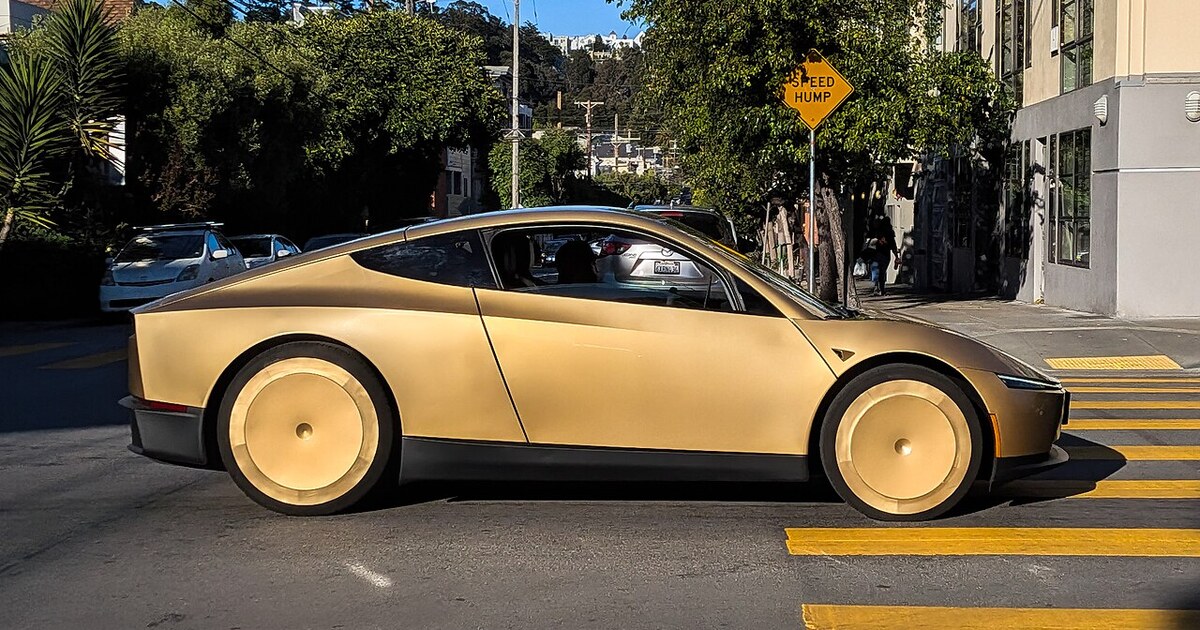
Original photograph used as this article’s hero image, by 9yz under CC BY 4.0; cropped for article and social previews.
This article was prepared with AI assistance and reviewed and approved by TrendPulse Analytics before publication.