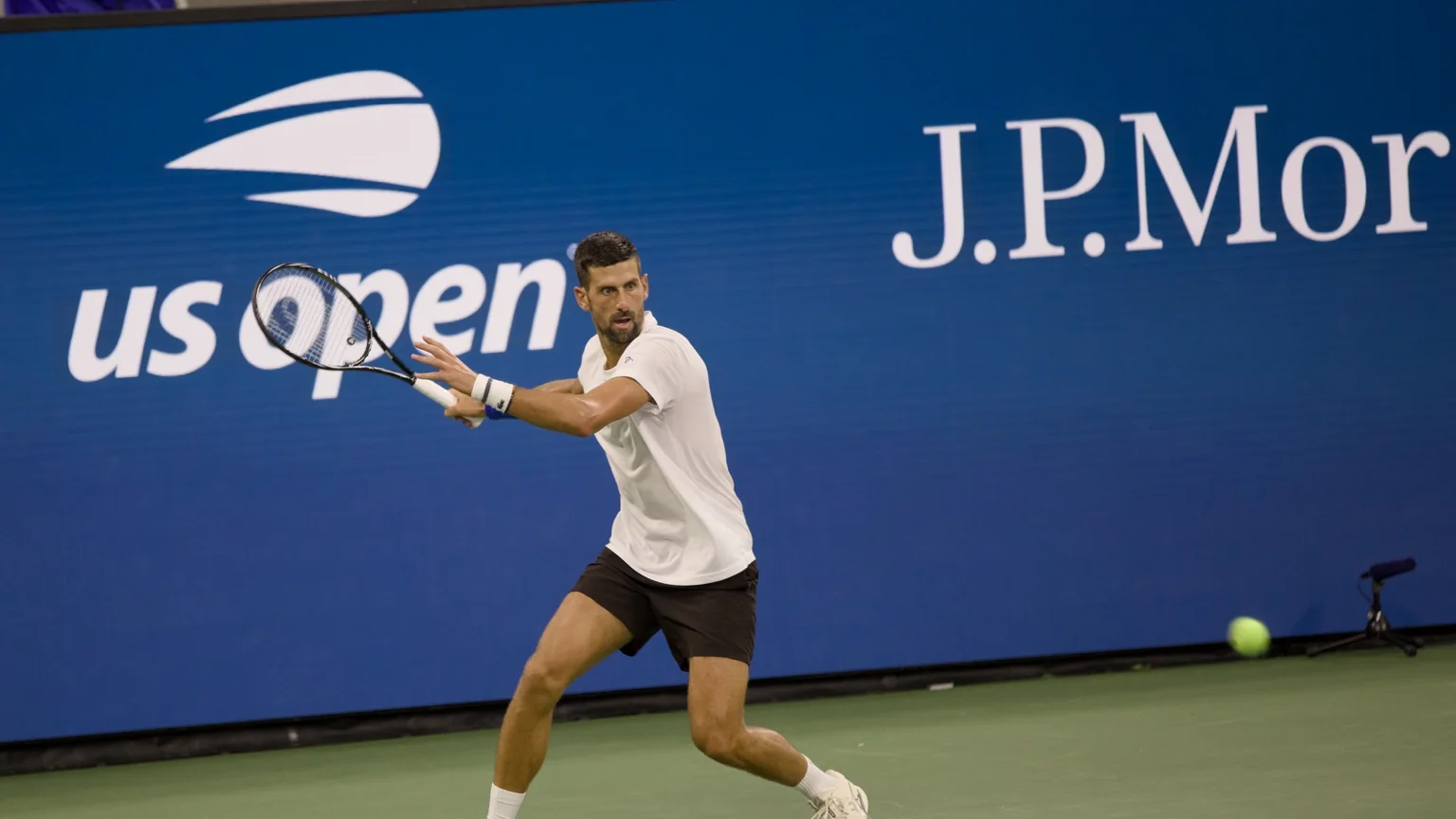
For most of Novak Djokovic’s career, five-set tennis has been the place where opponents discovered how difficult it was to finish him off.
On Sunday night in New York, the dynamic reversed.
Djokovic had recovered from losing the opening set against Mariano Navone. He won the next two and moved ahead by a break in the fourth. Against an unseeded opponent on Arthur Ashe Stadium, the 24-time Grand Slam champion appeared to have survived a difficult opening night at the U.S. Open.
Then his physical condition deteriorated.
Djokovic vomited during the match and dealt with cramping as well as back and shoulder problems. Navone recovered, took the fourth set and dominated the fifth to complete a 7-6(5), 5-7, 4-6, 6-2, 6-1 upset after four hours and 36 minutes.
It was Djokovic’s first opening-round loss at a Grand Slam since the 2006 Australian Open and the first time in 20 U.S. Open appearances that he had gone out in the first round. His attempt to win a record 25th Grand Slam singles title was over almost as soon as it began.
For a player whose career has been defined partly by extraordinary endurance and recovery, the significance goes beyond one upset.
Djokovic did not describe Sunday as an isolated physical problem.
He described something that has been happening repeatedly.
That may be the more important story.
This Was More Than a Bad Night
Upsets happen in tennis, including to great players late in their careers.
What makes this loss more difficult to dismiss is Djokovic’s own description of what happened.
Afterward, he said he had been dealing with vomiting during matches throughout much of the year, followed by cramping and pain. Against Navone, he said his back eventually gave way and his shoulder also became a problem.
The official U.S. Open account reported that Djokovic traced the difficulties back to the fourth game of the match and acknowledged that he considered retiring early before continuing.
Those are Djokovic’s descriptions of his symptoms—not a diagnosis and not evidence of any specific undisclosed medical condition.
But they change how Sunday should be interpreted.
If Djokovic had simply played poorly against an inspired opponent, the loss could be treated as an extraordinary but largely self-contained upset.
Instead, the match fits into a broader pattern of physical difficulties that Djokovic himself says have recurred during 2026.
There had already been warning signs.
At the Cincinnati Open earlier in August, Djokovic lost in the second round to Thiago Agustin Tirante after struggling in the heat and requiring medical treatment.
Days before the U.S. Open, Djokovic said the early Cincinnati defeat had at least provided additional preparation time, while acknowledging that opening matches at majors had become especially challenging for him in recent years.
He arrived in New York believing he had prepared as well as he could.
The first round showed how uncertain that preparation can become once a best-of-five match begins.
The Tennis Was Still There
The uncomfortable part for Djokovic is that Sunday did not necessarily look like a match involving someone who could no longer compete at the top level.
For substantial stretches, it showed the opposite.
After dropping the first-set tiebreak, Djokovic recovered to win the second and third sets. He then moved ahead in the fourth before the match turned sharply toward Navone.
That matters because athletic decline is rarely one thing.
A player can lose speed, power or tactical sharpness. Or a player can retain much of the skill required to win while becoming less able to sustain that level physically for several hours and then recover quickly enough to do it again.
Djokovic’s 2026 Grand Slam results demonstrate why the distinction matters.
He reached the Australian Open final in February, losing to Carlos Alcaraz, and advanced to the Wimbledon semifinals in July before falling to Jannik Sinner.
At Wimbledon, Djokovic had already survived a five-hour, 15-minute quarterfinal against Felix Auger-Aliassime before facing Sinner three days later.
Those are not the results of a player who has suddenly lost the ability to contend.
Djokovic also entered the U.S. Open ranked No. 5 in the world.
The problem is that winning a Grand Slam requires something more demanding than proving championship-level tennis still exists somewhere inside a player’s game.
It requires accessing it repeatedly.
A men’s major champion must win seven best-of-five matches over roughly two weeks. One exhausting early-round victory can affect the next match, and the consequences become more significant when recovery itself is part of the challenge.
At 25, spending four and a half hours surviving the first round may be an inconvenience.
At 39, it can become a substantial cost.
The Margin for Error Is Shrinking
Djokovic built one of the greatest careers in sports partly because of how often he could win when matches became uncomfortable.
That quality made long matches feel almost tilted in his favor. Opponents knew that winning two sets was not enough. They still had to finish the job against a player renowned for sustaining his movement, concentration and shot quality under enormous physical pressure.
Sunday inverted that advantage.
Djokovic had recovered from a set down. He had gained control of the scoreboard.
Yet once his physical problems became more limiting, the match moved quickly in the opposite direction.
Navone won the final two sets 6-2, 6-1.
That does not reduce the Argentine’s accomplishment.
Navone, ranked No. 49 entering the tournament, still had to remain composed against the most successful men’s Grand Slam player in history. The U.S. Open described the victory as the biggest of his career.
But the way the match unfolded illustrates how Djokovic’s margin for error may be changing.
Earlier in his career, losing a set or spending an additional hour on court did not necessarily threaten the larger tournament.
Now every additional set potentially carries more significance.
That becomes especially important at the Grand Slams, where Djokovic has increasingly concentrated his schedule and ambitions.
Twenty Years of History Ended in One Night
The result was historically unusual even before considering Djokovic’s physical condition.
His previous first-round loss at a major came at the 2006 Australian Open.
In New York, he had never lost his opening match.
Djokovic arrived at the 2026 U.S. Open with a 95-15 career record at the tournament and four titles. This was his 20th appearance.
And at 39, he was still pursuing the milestone that has hovered over the final stage of his career: Grand Slam title No. 25.
Djokovic has been on 24 since winning the 2023 U.S. Open.
The fact that the 25th has remained elusive does not mean he has stopped threatening to win it. Reaching the Australian Open final and Wimbledon semifinals this year is evidence of exactly why he continues trying.
But the route is becoming less forgiving.
His competition is no longer only the opponent scheduled that day.
It is also the accumulated physical demand of getting through enough matches to reach the final weekend.
Age Alone Doesn’t Explain It
Reducing all of this to Djokovic being 39 would be simple—and incomplete.
His age obviously matters in any discussion of workload and recovery. Elite tennis requires repeated acceleration, stopping, rotation and explosive movement over matches that can last several hours.
But Djokovic has also spent much of his career making conventional assumptions about athletic longevity look unreliable.
The stronger evidence now comes not simply from his birth date but from what he is reporting about his own experience.
He said after the Navone match that these physical problems have occurred repeatedly this year.
There is an important limit to what can responsibly be concluded from that.
Public reporting does not establish the cause of those symptoms, and it would be inappropriate to infer one.
What can be said is that recurring physical problems are harder to plan around than an ordinary bad performance.
Djokovic can reduce his schedule. He can prioritize recovery and train specifically for the majors.
What he cannot control is the draw.
He cannot guarantee that the first round lasts two hours instead of four and a half.
And that uncertainty matters more when the goal is not merely winning one match, but seven.
What Sunday Actually Changed
One first-round loss does not establish that Djokovic is finished.
His results this season make that conclusion especially difficult to defend.
Nor does Sunday prove that he cannot win another Grand Slam. An Australian Open final and Wimbledon semifinal in the same year provide substantial evidence that the level required to challenge for majors has not simply disappeared.
What changed is the uncertainty surrounding whether his body will consistently allow him to sustain that level.
Before the U.S. Open, durability was already part of the discussion around Djokovic’s pursuit of No. 25.
After the U.S. Open, Djokovic himself made clear that the concern is not theoretical.
He says the physical problems are recurring.
That leaves two separate questions surrounding every future major he enters.
Is his tennis still good enough to contend?
The evidence says it can be.
Can he remain physically capable of producing that tennis through enough best-of-five matches to win the tournament?
Sunday made that question harder to answer.
For most of Djokovic’s career, extraordinary physical resilience gave him time. He could stay in rallies longer, survive matches that seemed to be escaping him and remain near the top of tennis for longer than almost anyone imagined.
Now the relationship between time and Djokovic appears to be changing.
The longer a match lasts, the greater the possibility that physical durability becomes as important as forehands, serves or strategy.
Mariano Navone defeated Novak Djokovic at the U.S. Open.
But the lasting significance of the night may be what Djokovic revealed afterward.
At 39, the opponent becoming increasingly difficult for him to solve may not always be the player standing across the net.
It may be whether his own body allows him to stay there long enough to win.
Sources
- Reuters — Ailing Djokovic stunned in US Open first round by Navone
- US Open — Navone upsets Djokovic in 2026 US Open first-round stunner
- US Open — Djokovic on painful US Open defeat
- Reuters — Djokovic says early exit in Cincinnati helped him prepare for US Open
- ATP Tour — Djokovic prepared as best as can be ahead of US Open title bid
- ATP Tour — Alcaraz defeats Djokovic in 2026 Australian Open final
- ATP Tour — Djokovic defeats Auger-Aliassime in Wimbledon quarter-final
- ATP Tour — Djokovic reflects on 2026 Wimbledon semi-final
This article was prepared with AI assistance and reviewed and approved by TrendPulse Analytics before publication.