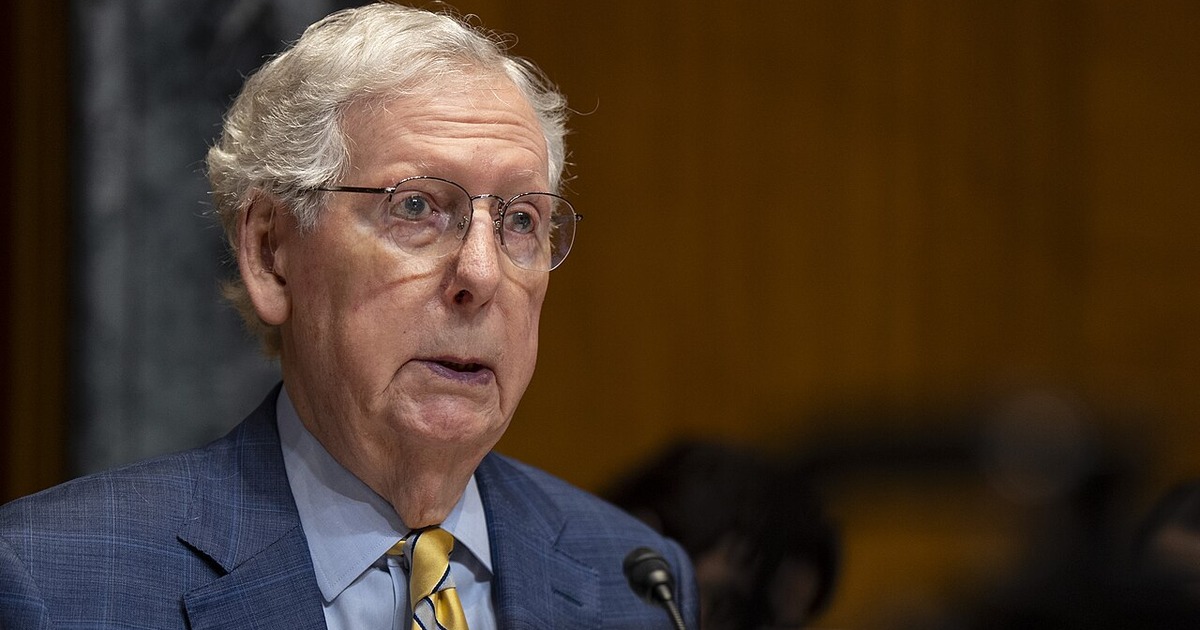
For roughly three months, one of the most recognizable members of the U.S. Senate was almost entirely absent from public view.
That changed Monday.
Sen. Mitch McConnell returned to the U.S. Capitol on September 14 for the first time since a June fall led to hospitalization, treatment for pneumonia and weeks of rehabilitation. McConnell also announced that he would return to the Senate floor and cast his first vote since June.
His reappearance resolves the most immediate mystery surrounding an absence that generated weeks of questions about his health and ability to complete his final Senate term.
But it does not mean McConnell considers himself fully recovered.
The 84-year-old Kentucky Republican acknowledged Monday that his recovery remains incomplete. He said he intends to resume Senate duties while continuing physical therapy and trying to be present for important votes.
That makes his return both an ending and another stage in the story.
To understand why McConnell simply appearing at the Capitol became significant, the timeline has to go back three months.
What happened to Mitch McConnell?
The current story began June 14.
McConnell was hospitalized after falling at his Washington home.
Initially, his office disclosed relatively little about why he had been hospitalized. That information gap contributed to increasing public speculation as the hospitalization stretched from days into weeks.
McConnell eventually addressed what happened in a July 12 statement.
He said he had suffered a fall, was briefly unconscious and was taken to the hospital. McConnell said doctors determined that he had not broken any bones and had not suffered a concussion, heart attack or stroke. He also said doctors had ruled out tumors and hemorrhaging.
During the hospitalization, McConnell was also treated for what he described as a mild case of pneumonia.
His doctors also pointed to a medical issue that has affected him for decades.
McConnell contracted polio as a child. The Office of the Attending Physician said the lasting effects of that illness remained a significant factor affecting his mobility and contributed to multiple falls.
McConnell’s recovery would ultimately keep him away from the Capitol for roughly three months.
Why did his absence become such a large story?
The length of the absence was one reason.
The lack of public visibility was another.
McConnell was hospitalized June 14 and did not return to the Capitol until September 14.
Outside of photographs released by his office, he had essentially disappeared from normal public view. There were no regular Capitol appearances, Senate-floor votes or typical interactions with reporters that would independently demonstrate how his recovery was progressing. Axios reported in August that he had not been seen publicly since the hospitalization except in images released by his office.
Meanwhile, McConnell continued to miss Senate business.
By the Senate’s September return, his absence had stretched to approximately 92 days, with reporting putting the number of missed Senate votes at around 60.
McConnell and his staff consistently maintained that he remained engaged with Senate work.
Top Senate Republicans also publicly said they had spoken with him during the hospitalization. Majority Leader John Thune, Majority Whip John Barrasso and former McConnell aide Scott Jennings described having substantive conversations with McConnell while speculation about his condition was circulating online.
But telephone conversations and statements from an office could not answer the most visible question:
When would McConnell actually return?
His rehabilitation lasted for weeks
McConnell eventually moved from the hospital into a rehabilitation facility.
His July statement made clear that he was not ready to return immediately to Washington.
He said he was working to regain his strength and intended to complete his term, which expires in January 2027. McConnell has already announced that he will not seek another Senate term.
Then came another milestone on August 6.
McConnell announced that he had been discharged from the rehabilitation facility and returned home.
He said he would continue an intensive regimen of physical therapy while remaining engaged with his staff and Senate colleagues.
But even that announcement did not establish when he would physically return to Capitol Hill.
The uncertainty continued through the Senate’s five-week summer recess.
The information gap fueled speculation
The unusual combination of McConnell’s age, previous health incidents, extended hospitalization and lack of public appearances created an environment in which rumors spread quickly.
Kentucky Gov. Andy Beshear publicly requested additional information about McConnell’s condition in July, arguing that Kentuckians deserved an update on whether their senator was able to perform his responsibilities.
McConnell subsequently provided more details about the fall and pneumonia.
But questions continued because he still had not returned publicly.
Axios reported that the information vacuum generated widespread online speculation about McConnell’s condition. The senator’s eventual disclosure established several important facts, but it did not eliminate the central uncertainty surrounding his return.
That is what makes September 14 different.
McConnell is no longer merely communicating through statements, photographs or conversations described by colleagues.
He has physically returned to the Capitol.
What about the police outside McConnell’s home?
The security presence outside McConnell’s Washington residence also became part of the public discussion surrounding his absence.
But it is important to separate what was observed from what was established.
There was a significant emergency response at McConnell’s residence on June 14, the day he was hospitalized.
CNN reported that a neighbor observed ambulances, a firetruck and Capitol Police on the street that morning. According to the neighbor, a Capitol Police officer said there was a medical emergency but did not identify who it involved. A person was later taken from McConnell’s home by stretcher.
Later reports also described security vehicles outside the residence during McConnell’s prolonged recovery.
The existence of police or security outside the home, however, did not by itself establish that another emergency had occurred.
There was no verified basis to describe the later security presence as a raid, investigation or new medical crisis.
That distinction became particularly important as photographs and posts about McConnell’s residence circulated while he remained out of public view.
The confirmed June emergency and later security observations were real.
Claims about what the later security presence meant were not established.
Why his return matters for the Senate
McConnell is no longer the Senate Republican leader, but he remains a sitting senator and therefore retains a vote.
His prolonged absence had practical consequences.
One of the clearest examples involved the farm bill.
McConnell serves on the Senate Agriculture Committee. During his absence, his inability to be physically present complicated the committee’s work on the legislation.
Axios reports that McConnell’s return could now help move the stalled farm bill forward.
His return also restores his ability to cast Senate floor votes.
A senator can continue communicating with staff, reviewing legislation and conducting some work away from Washington.
Floor voting is different.
McConnell’s return therefore provides something that months of statements from his office could not: his physical presence in the institution where his vote is required.
McConnell says he is not fully recovered
The return should not be interpreted as a declaration that McConnell’s health has returned to where it was before June.
McConnell himself said otherwise.
In his Monday statement, he acknowledged the difficulty of his recovery and the continuing effects of childhood polio. He said he is not fully recovered and intends to continue physical therapy while resuming Senate work.
That makes the next phase different from the previous three months.
The primary question is no longer whether McConnell will appear again at the Capitol.
He has.
The question now is what his Senate schedule looks like as he continues recovering.
McConnell has indicated that he intends to be present for important votes while following his doctors’ recommendations.
His attendance over the coming weeks will provide more information about what that means in practice.
What is actually known about his health?
Despite months of speculation, the publicly established medical timeline is relatively straightforward.
McConnell fell at his Washington home on June 14.
He was briefly unconscious and hospitalized.
He said doctors ruled out broken bones, a concussion, heart attack, stroke, tumors and hemorrhaging.
He was treated for mild pneumonia.
His childhood polio complicated his mobility and rehabilitation.
He spent weeks receiving inpatient rehabilitation before being discharged August 6 to continue intensive physical therapy at home.
And on September 14, roughly three months after the original hospitalization, he returned to the U.S. Capitol.
McConnell says the recovery is still ongoing.
Those are the established facts.
The more dramatic theories that circulated during his absence were not necessary to explain what happened.
What his return resolves—and what it doesn’t
McConnell’s reappearance answers the largest immediate question surrounding the story.
He has returned to Washington.
He intends to vote again.
And his office’s repeated statements that he planned to resume Senate duties now have a visible result.
But the return does not answer every question about the remaining months of his term.
It remains unclear how frequently McConnell will be physically present, how much his continuing rehabilitation will affect his schedule and whether he will be able to maintain regular attendance through January.
Those questions will be answered by what happens next rather than speculation about what happened while he was away.
The timeline now has a resolution that it did not have even hours earlier:
June 14: McConnell falls at his Washington home and is hospitalized.
July 12: He publicly reveals that he was briefly unconscious and was treated for mild pneumonia while doctors ruled out several more serious conditions.
August 6: McConnell leaves inpatient rehabilitation and continues intensive physical therapy at home.
September 14: McConnell returns to the U.S. Capitol for the first time in roughly three months and says he will resume Senate voting.
For much of the summer, the story surrounding Mitch McConnell was defined by what the public could not see.
His hospitalization was initially unexplained. His rehabilitation lasted for weeks. Public appearances stopped. Senate votes accumulated without him. Photographs and security outside his residence attracted attention while speculation filled the information gap.
September 14 changes that.
McConnell has resurfaced.
His return does not mean his recovery is complete, and it does not establish how active he will be during the remaining months of his final term.
But it resolves the question at the center of the story:
Mitch McConnell is back at the Capitol. What comes next will now be measured not by his absence, but by how much of his Senate role he is able to resume.
Sources
- Axios — “McConnell returns to Capitol after 3-month absence,” September 14, 2026
Current reporting confirming McConnell’s physical return to the U.S. Capitol after approximately three months and the legislative implications of his return. - Associated Press — “McConnell says he’ll vote in Senate for the first time since his hospitalization in June,” September 14, 2026
Reporting on McConnell’s return, his first Senate vote since June and his statement that his recovery remains incomplete. - Associated Press — McConnell discloses fall and hospitalization, July 12, 2026
Reporting on McConnell’s fall, brief unconsciousness, pneumonia, medical testing and rehabilitation. - Axios — “McConnell breaks weeks of silence about his hospitalization,” July 12, 2026
Reporting on McConnell’s account of the June fall, pneumonia and the role of his post-polio condition in his mobility problems. - Axios — “McConnell discharged from rehab center, Senate return still unclear,” August 6, 2026
Reporting on McConnell’s discharge from inpatient rehabilitation and continuation of intensive physical therapy at home. - Axios — “Inside the McConnell health rumor mill,” July 7, 2026
Reporting on conversations between McConnell and Senate Republican leaders during his hospitalization and the speculation generated by limited public information. - CNN — July 10, 2026 reporting on the June 14 emergency response
CNN reporting based on a neighbor’s account of ambulances, a firetruck and Capitol Police at McConnell’s residence on the morning of his hospitalization.
This article was prepared with AI assistance and reviewed and approved by TrendPulse Analytics before publication.